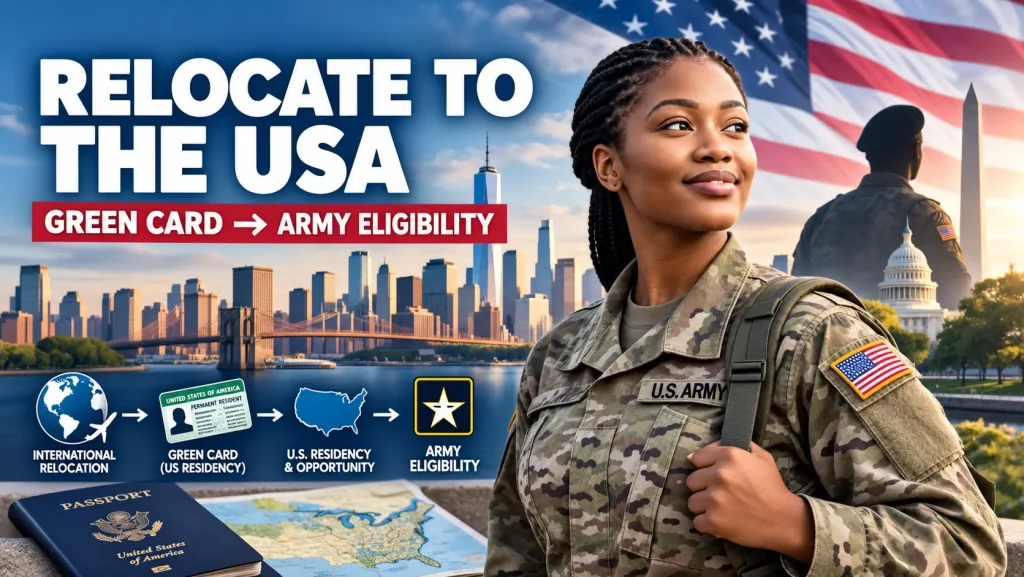
Military service can create special naturalization opportunities for certain current and former members of the U.S. armed forces. It does not replace a Green Card, it does not make citizenship automatic, and it is not an open visa for people who are still living abroad. The usual order for most noncitizens who hope to enlist is still lawful permanent residence first, then military eligibility, then — if the person qualifies — a naturalization filing under the military provisions. Navigating this rigid federal framework allows strategic applicants to securely accelerate their timeline toward civic status while building high-paying careers in specialized defense infrastructure.
This guide separates those stages so readers do not confuse enlistment with immigration or naturalization with a guaranteed passport. Verify current rules with USCIS military naturalization information, USA.gov guidance on joining the military, and an official recruiter for the branch you are considering. Beyond the profound acceleration of citizenship status, foreign nationals who enter these structured tracks gain access to elite government-backed benefits, including comprehensive VA healthcare networks, thrift savings retirement plans, and specialized federal banking packages designed specifically for high-earning service personnel.
When pursuing expedited citizenship through specialized defense tracks, verifying your processing steps through official federal databases is paramount. Legitimate applicants must navigate their filings transparently within the frameworks governed by U.S. Citizenship and Immigration Services (USCIS) and the Department of Defense (DoD). Successfully filing an official Form N-400 under Section 328 or 329 of the Immigration and Nationality Act (INA) ensures your military naturalization track satisfies all active-duty or honorable discharge statutory requirements.
Bypassing common structural bottlenecks requires an exact approach tailored strictly to standard military entrance processing command regulations. International applicants must clear comprehensive background check metrics, maintain valid permanent residency documentation, and meet specific physical and educational baselines before heading to any enlistment processing station. Because specialized engineering, linguistic, and medical branches face persistent technical vacancies, recruiters prioritize highly qualified assets. Review the step-by-step instructions below covering mandatory requirements, physical verification timelines, and how to apply to position your file directly at the top of the processing queue.
Enlistment and Citizenship Are Different Processes
USA.gov states that a noncitizen who wants to join the U.S. military generally must have a valid Permanent Resident Card and must be able to speak, read, and write English fluently. Each branch also applies its own age, education, testing, medical, and fitness standards. A Green Card is one eligibility item, not a job offer from the Army.
Naturalization is the process of becoming a U.S. citizen after meeting the Immigration and Nationality Act requirements. Military naturalization changes some of the residence and physical-presence rules that apply to many civilian applicants. It does not erase criminal, good-moral-character, or documentation problems, and it does not mean every service member is approved.
If you are still overseas without permanent residence, start with a lawful immigration route rather than a recruiter. Employment-based options are discussed in the EB-3 visa sponsorship jobs and EB-2 Green Card requirements guides. The broader sequence is explained in how to relocate to the U.S. with Green Card pathways related to Army enlistment eligibility.
The Two Main Military Naturalization Provisions
USCIS describes special naturalization rules under two well-known sections of the Immigration and Nationality Act. Which one applies depends on the nature and timing of the service.
Section 328 — peacetime service
Section 328 generally relates to naturalization based on honorable service during peacetime. USCIS explains that this route typically requires at least one year of service and, in the usual case, lawful permanent resident status. Other naturalization requirements, including good moral character for the relevant period, still apply. Applicants should read the current USCIS page rather than assuming that one year of any military work is enough.
Section 329 — service during designated hostilities
Section 329 relates to service during designated periods of hostilities. USCIS has treated the period beginning September 11, 2001, as such a period, but designations and implementation can change. This provision can alter some of the usual residence requirements and, in some cases, the immigration-status starting point. It still depends on qualifying service, honorable characterization where required, and the rest of the naturalization statute.
Do not decide which section you fall under from a social-media summary. The dates of service, the character of service, and the forms you file all matter.
Related Guide: Green Card pathways and U.S. Army enlistment eligibility — why lawful permanent residence generally comes before enlistment, and why the Army is not a visa program.
What Qualifying Service Usually Involves
USCIS looks at more than a uniform. Typical issues include:
- Whether the service was in the U.S. armed forces, including the selected reserve in some provisions.
- Whether the service was honorable, and whether any discharge characterization creates a bar.
- Whether the applicant completed the required period or served during a qualifying hostility period.
- Whether immigration status, where required by the section being used, is documented.
A recruiter can talk about enlistment standards. A recruiter is not a substitute for USCIS when the question is citizenship. Military legal assistance or a qualified immigration lawyer may be appropriate if the record is complicated.
Forms and Documents
USCIS’s military naturalization materials commonly discuss:
- Form N-400, Application for Naturalization.
- Form N-426, Request for Certification of Military or Naval Service, where it is required to document service.
- Proof of identity, permanent residence where required, and military service records.
- Other supporting documents listed on the current USCIS checklist, which can include tax, residence, and good-moral-character evidence.
Keep original civil documents and complete copies of immigration filings. Name mismatches between a passport, Green Card, and military records should be fixed with legal documents, not ignored.
Some military naturalization filings have had fee or location differences compared with ordinary civilian N-400 cases. Those administrative details change. Check the current USCIS fee schedule and filing instructions rather than an old blog post.
English, Civics, and Character
Military provisions can reduce or change some residence and physical-presence requirements. They do not automatically cancel English and civics testing or good-moral-character review. USCIS can still deny a case for disqualifying crimes, false testimony, or other statutory bars.
People who enlisted as permanent residents should not assume that wearing a uniform repairs prior immigration fraud, unlawful employment, or unreported criminal history. Those issues should be reviewed before anyone files N-400.
A Practical Order of Operations
- Identify a lawful way to become a permanent resident if you are not one already. Family and employment routes are different; see family-sponsored Green Card pathways and EB-3 visa sponsorship jobs in the USA.
- After you have the required immigration status, contact an official military recruiter. Ask about current age, education, ASVAB, medical, and English standards.
- Complete enlistment only if you qualify. Do not treat online “Army to Green Card” ads as official policy.
- During or after qualifying service, review USCIS military naturalization rules and the correct INA section.
- File the naturalization application with complete evidence. Attend biometrics, interview, and oath steps if USCIS approves the case.
Each numbered item can fail on its own. That is why stacking them into one paid “package” from a private consultant is risky.
Civilian Employment Is Still Separate
Some applicants want to work in the United States first and consider military service later. Lawful work requires its own status: a nonimmigrant work visa, an Employment Authorization Document in categories that use one, or permanent residence. See how to get a U.S. work visa and how to find U.S. employers that sponsor foreign workers if civilian employment is the current step.
Do not mix a civilian job ad with a military naturalization promise. Employers do not naturalize you, and the Army does not sponsor EB-2 or EB-3 petitions as a substitute for a U.S. company.
Warning Signs
Treat the following as caution lights:
- Ads that say you can fly to the United States to enlist without a Green Card.
- Guaranteed citizenship in a fixed number of days after boot camp.
- Someone asking you to pay a recruiter fee for a military slot.
- Documents that tell you to hide prior immigration history from USCIS or from the military.
Official recruiting happens through the U.S. military. Official naturalization decisions happen through USCIS.
Frequently Asked Questions
Can I join the U.S. Army to get a Green Card?
Generally, no. U.S. government guidance is that you cannot join the military as a way to enter the United States or obtain a visa. Permanent residence usually comes first.
Does every Green Card holder qualify to enlist?
No. Immigration status is only one requirement. Age, education, English, testing, medical standards, and other branch rules still apply.
Is citizenship automatic after one year of service?
No. Military provisions can create a special route or reduced requirements. USCIS still has to approve a naturalization application.
What is the difference between Section 328 and Section 329?
Section 328 is generally associated with peacetime service and typically involves a service-time requirement plus permanent resident status in the usual case. Section 329 is associated with designated hostilities and can change some ordinary requirements. Read the current USCIS explanation for your dates of service.
Do I need Form N-426?
USCIS uses Form N-426 to certify military service in many of these cases. Follow the current form instructions for your filing.
Can my family become citizens because I enlisted?
Family members have their own immigration and naturalization rules. Enlistment does not automatically naturalize a spouse or child. Family-sponsored Green Card options are a separate topic.
Who can give legal advice on my case?
A licensed U.S. immigration attorney or another representative authorized to provide immigration legal services. Websites, recruiters, and consultants who are not authorized should not be treated as legal counsel.
What to Read Next
These guides stay on the same U.S. immigration and employment topic. Read the one that matches your next question.