Family-sponsored immigration remains one of the primary legal frameworks for individuals aiming to secure lawful permanent residency within the United States. This pathway stands entirely separate from employment-based visa classifications like EB-2 or EB-3, and it is completely isolated from U.S. military enlistment programs. If you possess a qualifying familial relationship with a U.S. citizen or a lawful permanent resident, this route serves as a far more relevant and secure alternative to pursuing an enterprise corporate sponsor. However, if that biological or legal relationship does not exist, family-sponsored language embedded within commercial advertisements will not create a viable immigration pathway.
This comprehensive guide summarizes exactly how USCIS and the Department of State describe family-based immigrant categories, how corporate and relative petitions move through the official pipeline, and how to identify and avoid predatory “fast-track” migration scams. Confirm the current preference caps and processing forms directly on the official USCIS family preference and immediate relatives portals. Beyond the profound legal advantage of securing a permanent Green Card, foreign nationals successfully completing these high-paying legal tracks gain immediate access to comprehensive North American infrastructure, including elite domestic retail banking packages, private asset management resources, and high-limit consumer credit facilities optimized for high-earning newcomers.
When pursuing lawful permanent residency via family-sponsored classifications, verifying your processing timeline through official federal databases is paramount. Legitimate petitioners must operate transparently within the strict frameworks governed by U.S. Citizenship and Immigration Services (USCIS) and the National Visa Center (NVC). Successfully filing an official Form I-130 (Petition for Alien Relative) and monitoring priority date movements on the monthly Department of State Visa Bulletin ensures your permanent residency track satisfies all federal statutory requirements.
Bypassing common processing pitfalls requires a meticulous approach tailored strictly to standard American immigration compliance rules. International applicants must prepare verified civil documentation, clear biographic background records, and comprehensive financial sponsorship affidavits to prove compliance with strict federal poverty guidelines. Because the legal transition involves substantial cross-border shifts, verified applicants are moving quickly to lock in their document queues. Review the step-by-step instructions below covering mandatory forms, relationship verification metrics, and how to apply to position your petition directly at the top of the consular processing stack.
Two Broad Groups
Family-based immigrant visas are commonly divided into immediate relatives of U.S. citizens and family preference categories.
Immediate relatives of U.S. citizens
USCIS treats certain close relatives of U.S. citizens as immediate relatives. In general terms, that group includes a spouse, an unmarried child under 21, and a parent of a U.S. citizen who is at least 21. Immediate-relative visas are not subject to the same annual numerical limits as the preference categories, which is why they are often faster — but “faster” still depends on the petition, the consulate or adjustment process, and the facts.
Family preference categories
Other relationships are grouped into preference categories, which do have annual limits. The Department of State Visa Bulletin then becomes important. Waits can be short or extremely long depending on the category and the country of chargeability. Typical preference groups, as described by USCIS, include unmarried adult sons and daughters of U.S. citizens, spouses and children of lawful permanent residents, unmarried adult sons and daughters of permanent residents, married sons and daughters of U.S. citizens, and brothers and sisters of adult U.S. citizens.
Do not memorize a wait time from an old video. Open the current Visa Bulletin for the category that actually matches your relationship.
Who Files What
The U.S. citizen or lawful permanent resident relative is usually the petitioner. The typical first filing is Form I-130, Petition for Alien Relative. Approval of the I-130 establishes the relationship for immigration purposes. It is not the Green Card.
After the petition stage, the case either goes through consular processing with the Department of State if the applicant is abroad, or through adjustment of status with USCIS if the applicant is in the United States and eligible to adjust. Eligibility to adjust depends on lawful entry and other statutory rules. People who entered without inspection, overstayed, or worked without authorization can face bars that a simple I-130 approval does not erase.
Some cases also involve an affidavit of support. Financial requirements exist to show that the intending immigrant is not likely to become a public charge under the rules in effect at the time of decision. Those rules are detailed and should be read from current USCIS instructions, not from a recruiter’s summary.
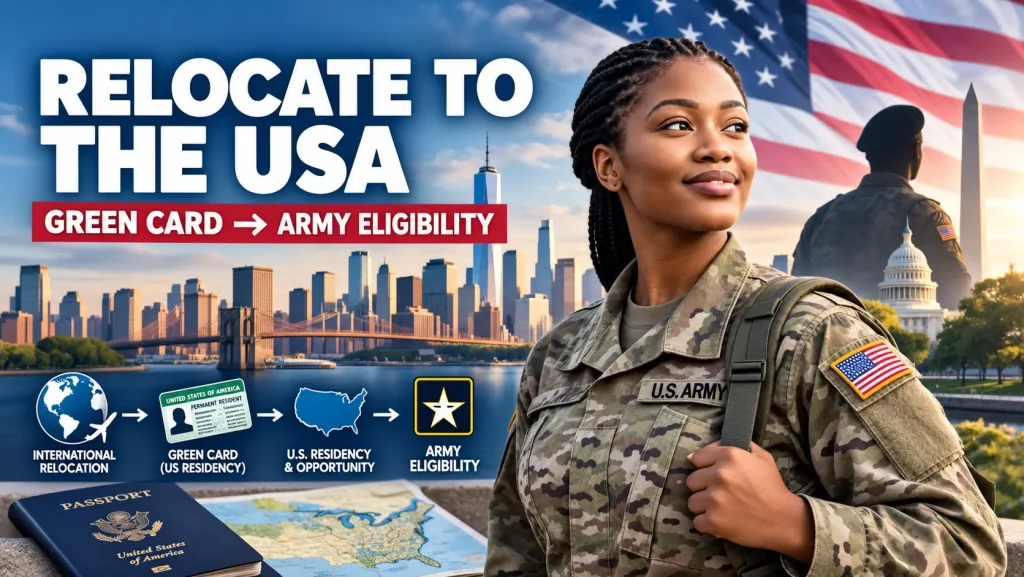
Related Guide: Green Card pathways and U.S. Army enlistment eligibility — why family or employment immigration usually has to succeed before military enlistment is even possible.
Family Immigration Versus Employment Sponsorship
Family cases are built on a qualifying relationship. Employment cases are built on a job and, in most EB-2 and EB-3 filings, an employer. Mixing the two in one paid “package” is a common source of confusion.
If you do not have a qualifying relative, looking at how to find U.S. employers that sponsor foreign workers, EB-3 visa sponsorship jobs, or EB-2 Green Card requirements is the more logical path. If you do have a qualifying relative, starting with a family petition may avoid years of searching for a company that will file PERM.
Marriage-based cases receive extra scrutiny around whether the relationship is genuine. Fraud findings can carry long-term bars. Do not use a paid marriage as an immigration product.
Documents That Usually Matter
Exact checklists depend on the relationship and the processing post. Applicants and petitioners should expect to gather:
- Proof of the petitioner’s U.S. citizenship or permanent residence.
- Proof of the family relationship: marriage certificates, birth certificates, divorce decrees, and adoption records where relevant.
- Certified translations of documents that are not in English.
- Identity documents that use consistent names, plus legal evidence of any name change.
- For consular cases, civil documents the National Visa Center and the embassy request.
Missing divorces, unregistered marriages, and unexplained name differences delay more family cases than any slogan about “fast-track processing.”
What Family Sponsorship Does Not Do
A family petition does not:
- Authorize the relative to enlist in the U.S. Army before becoming a permanent resident, except in unusual situations that you must verify with official military and USCIS sources — not with an ad.
- Replace employment authorization rules while the case is pending, unless a specific work-permit category applies.
- Guarantee that a preference-category case will finish in a few months when the Visa Bulletin shows a backlog.
- Cure prior removal orders, false claims to citizenship, or smuggling findings by itself.
After permanent residence is granted, the new Green Card holder may later look at civilian work, travel rules, or — if they choose and qualify — military enlistment and then military naturalization. Those are later chapters, not benefits of filing I-130.
If You Have Both Family and Employment Options
Some people have a sibling petition with a long wait and also a skilled occupation that might support EB-3. Others have a U.S. citizen spouse and do not need an employer at all. The better filing depends on relationship strength, admissibility, and timing. It is reasonable to get legal advice before dropping one path for the other.
Employment-based readers can still use the USA visa sponsorship jobs guide and U.S. work visa overview if family is unavailable. Do not invent a cousin relationship to match a YouTube script.
Scam Patterns in Family Immigration
- Someone offers to “add you” to another family’s petition.
- A stranger proposes marriage in exchange for a fee.
- A consultant guarantees an immediate-relative timeline for a preference-category relationship, such as a sibling.
- You are told to hide a prior marriage or a child from USCIS.
USCIS and consular officers compare civil records across years. Gaps are often visible.
A Practical Sequence
- Identify the exact relationship and whether the petitioner is a U.S. citizen or a permanent resident.
- Read the current USCIS page for that relationship and Form I-130 instructions.
- Collect civil documents and translations.
- File the petition and keep the receipt number.
- Track whether the case is current on the Visa Bulletin if it is a preference category.
- Complete consular processing or adjustment of status only if you are eligible for that step.
- After a Green Card is issued, follow residence, tax, and travel rules. Military plans, if any, come after that.
Frequently Asked Questions
Can a brother or sister sponsor me quickly?
Brothers and sisters of adult U.S. citizens fall in a preference category with annual limits. Some countries have long waits. Immediate-relative cases are the ones more often described as having no annual cap.
Can a Green Card holder sponsor parents?
Parents of U.S. citizens who are 21 or older are generally immediate relatives. A lawful permanent resident cannot use that same immediate-relative parent category. Check the current USCIS charts for what a permanent resident may petition for.
Does an I-130 let me work in the United States?
Not by itself. Work authorization depends on status, pending adjustment in eligible cases, or another visa. Do not start work just because a petition was filed.
Can I switch from a family petition to EB-3?
People sometimes have more than one immigrant petition in their history. Whether a later employment case helps depends on priority dates, eligibility, and legal advice. The categories remain different.
Will family sponsorship help me enlist?
Only indirectly, if it leads to lawful permanent residence and you then meet military standards. The family petition is not an enlistment application.
Do I need a lawyer?
USCIS allows self-filing. Complicated histories, prior removals, or marriage-fraud concerns are reasons to consult a qualified immigration attorney.
Where do I check wait times?
The Department of State Visa Bulletin for preference categories, plus USCIS processing times for the form and field office or service center involved. Both move.
What to Read Next
These guides stay on the same U.S. immigration and employment topic. Read the one that matches your next question.